
FAQs for the Safe Sidewalks Crew
-
Use our handy lookup tool at www.pittsburghwalks.org/username-lookup or email support@pittsburghwalks.org if it’s not working.
-
Watch a 15 minute recap of the training [here].
Email support@pittsburghwalks.org for a link to watch the full training with ASL interpretation.
-
Most Safe Sidewalks Crew walks and sidewalk audits will include sections with sidewalks that have structural issues and obstructions, and are out of compliance with ADA. But, of course, this work couldn’t exist without the insights of people with disabilities. When you register for a walk, feel free to let us know if you use a mobility device or have individual accessibility questions, and we will coordinate with you to find a feasible route and accessible meeting point.
-
Participants who are blind or have low vision may not be able to use the mobile survey application, but your input is very valuable. You can be paired with another participant who will enter responses while you share your observations.
-
We have adapted the online app/form as we received feedback from community volunteers. We will try to keep you updated on changes, but if you have any questions please reach out to us at support@pittsburghwalks.org!
-
We recommend uploading 1-2 photos, and you don't need to upload any. If you have a phone with a really good camera the images will be high enough quality that they may take several minutes to upload which will slow down your process. Photos are best for abnormal or possibly difficult to locate issues to help DOMI understand what you are trying to report.
-
Logging these issues/chronic problems will help the city know they need to create alternative solutions for neighborhoods.
-
People with disabilities, seniors, and people with strollers need to have access to sidewalks all the time to get to their destinations. People who rely on mobility devices in particular can't simply step around or move the object. It is also unsafe to create a situation where someone has to walk out into the street to get around an obstruction, even if temporary.
-
Stairs are handled separately from the sidewalk concerns. If there are stairs in a stretch of sidewalk you are reporting, just submit your report based on the stretches of actual sidewalk and do not include the stairs in your assessment.
-
311 gets it done! 311 is a non-emergency service request form through the city. It is for issues that need to be fixed immediately. Unlike our sidewalk assessment, the 311 system wants detailed information of the issues so that the city has a better idea of what needs to be fixed and exactly where. The 311 submission can be found at https://pittsburghpa.my.site.com/311/s/ and Bike Pittsburgh has a guide on how to use it https://bikepgh.org/sites/advocacy/resources/report/
-
When this tool first came into creation it was because advocates went to DOMI saying they wanted to map the gaps in sidewalk quality without citing low income homeowners, so that was a piece built into the project from the beginning. The goal is to help the city determine where it can do the most good by repairing large stretches of sidewalk, and to show the need for continued dedicated funds to assist low income homeowners in maintaining their sidewalks.
-
Please be as concise as possible. This assessment is for a very general overview and the city will do a more thorough assessment based on noted areas of concern. "Other" categories should be used only for when you note issues that are not covered well by the specific assessment responses.
-
It is still good to note it in our assessment, because the construction might not have the proper permitting or the appropriate signage, the construction can last far past when it was supposed to be completed, and the associated signs and blockades can mistakenly be left up after construction is over. For the purposes of our assessment, please take note of construction.
-
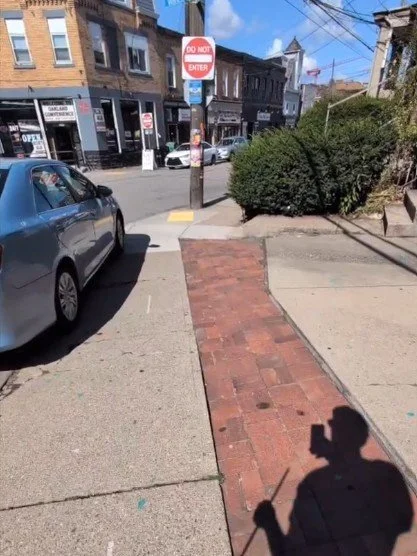
Brick sidewalks can add a welcoming, historic character to a neighborhood street. They are considered safe and accessible when they are well-maintained. However, just like any sidewalk, please indicate any unevenness or gaps greater than 1/4-inch or broken bricks as a structural issue in the survey.
-
DWS stands for Detectable Warning Surface. It is the fancy term for the bumpy surface that is usually yellow and is on the curb ramp. The little round bumps are raised so they can be felt underfoot or with a sight cane for pedestrians who are blind, and the bright yellow shows up more clearly for people who have low vision.
-
Please report this as ADA ramp is missing or in poor condition.
-
ADA ramps on sidewalks, also known as curb ramps, are ramps built into the curb on sidewalk crossings to provide access for people using mobility equipment such as wheelchairs, scooters, or walkers. The ramps ensure that sidewalks are accessible to everyone, which is required by the Americans with Disabilities Act (ADA). They do this by creating a smooth switch from the sidewalk to the pavement.
-
If sidewalks are accessible to people with disabilities, anyone can use them. Ramps also help people with bikes, strollers, and shopping carts.
-
It is used for reporting sidewalk conditions/quality to City of Pittsburgh (DOMI), supporting sidewalk accessibility, and to help City of Pittsburgh sending resources ($) where they are needed.
-
DOMI is the acronym for the cuty's Department of Mobility and Infrastructure: https://www.pittsburghpa.gov/Business-Development/Mobility-and-Infrastructure
-
We are a coalition of passionate individuals and reps from organizations with communities that rely on walking to get around. Pittsburgh Walks advocates for infrastructure, programs and policies to improve safety, accessibility, and enjoyment for people who walk in the City of Pittsburgh including people with disabilities. They envision walking infrastructure that is accessible and enjoyable throughout all 90 neighborhoods.